Leave Your Message
An Electric Vehicle Mold is a precision tool used to shape components for electric cars. It may form battery trays, charging housings, interior panels, connectors, or lightweight structural parts. These molds commonly use steel or aluminum, depending on production volume, material choice, and required durability. Their surfaces can be smooth, textured, or engineered with small channels for cooling.
The working process begins with a digital component design. Engineers check wall thickness, shrinkage, airflow, and release angles before machining the mold. During injection molding, heated plastic enters the cavity under controlled pressure. The material fills each narrow section, cools against the mold walls, and hardens into the required shape. The mold then opens, and ejector pins remove the finished part.
Small details matter.
A difference of a few tenths of a millimeter can affect fit, sealing, or assembly speed. Cooling lines also influence cycle time and surface quality. Experienced mold makers test these factors through simulations, trial runs, dimensional inspections, and material checks. Reliable suppliers document the steel grade, temperature settings, maintenance history, and inspection results.
However, no mold performs perfectly forever. Wear, trapped air, uneven cooling, or incorrect pressure can create warping and visible marks. This article explains how an Electric Vehicle Mold works, where its main challenges appear, and why careful design supports safer, more consistent vehicle production. Some project decisions remain difficult. A cheaper mold may reduce initial cost, but later repairs can weaken that advantage.
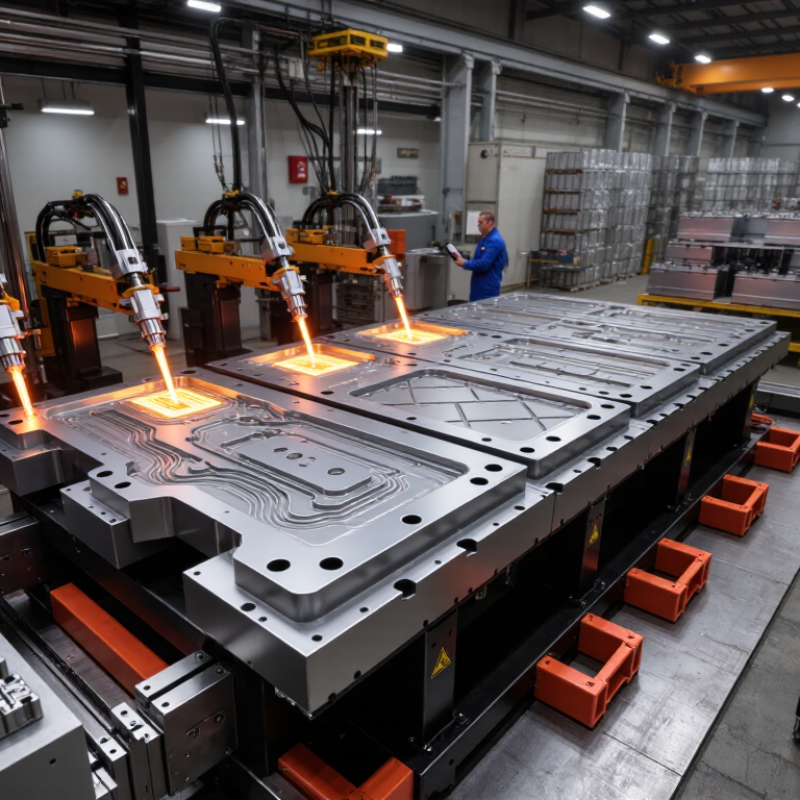
An electric vehicle mold is a precision tool that shapes components through injection molding, compression molding, or metal forming. It may produce battery covers, charging housings, cable connectors, interior panels, or lightweight structural parts. Its role is not merely cosmetic. The mold controls dimensions, surface quality, cooling behavior, and production repeatability. According to the International Energy Agency’s Global EV Outlook 2025, electric car sales exceeded 17 million in 2024, passing 20% of global car sales. That growth increases pressure for stable, high-volume tooling.
A practical mold begins with digital part data, material analysis, and flow simulation. Engineers then select tool steel or aluminum, design cavities, and place cooling channels near heat-sensitive areas. Uniform cooling helps prevent warpage and uneven shrinkage. Ejector pins must release the part without marks or distortion. For battery-related components, sealing surfaces require especially careful dimensional inspection. The U.S. Department of Energy identifies lightweighting and manufacturing efficiency as important pathways for improving vehicle energy performance.
The process is less perfect than drawings suggest. A part can pass simulation and still deform during real production. Resin moisture, tool temperature, and small venting errors may change results. Experienced technicians therefore check first-off samples, measure critical points, and adjust the mold gradually. It is a slower approach, but often safer. A reliable electric vehicle mold balances cycle time, durability, repair access, and consistent part quality. In practice, the best design is not always the most complicated one.
| Data Dimension | Definition or Typical Data | How It Works in Electric Vehicle Production | Primary Value |
|---|---|---|---|
| Definition | An electric vehicle mold is a precision tool or die used to shape, form, inject, compress, or cast materials into components for an electric vehicle. | The mold provides a controlled cavity or forming surface that determines the component's geometry, surface finish, and repeatability. | Enables consistent mass production of components with defined dimensions and functional features. |
| Main forming methods | Injection molding, compression molding, die casting, stamping, thermoforming, and resin transfer molding. | A selected material is forced, pressed, cast, or heated into the mold or die before cooling, curing, or solidifying. | Matches the manufacturing method to the component's material, structural requirements, and production volume. |
| Typical EV applications | Battery enclosures, cell holders, busbar covers, connector housings, charging-port parts, interior panels, exterior body panels, motor housings, and thermal-management parts. | Each mold is designed around the component's geometry, assembly interfaces, insulation needs, sealing surfaces, and thermal or mechanical loads. | Supports the production of lightweight, electrically safe, and precisely assembled vehicle systems. |
| Mold construction materials | Tool steels are common for high-volume tooling; aluminum and other machinable metals may be used for prototypes, lower-volume production, or faster tool manufacture. | The tool material is selected according to production quantity, molding pressure, temperature, wear, corrosion, and required tool life. | Balances durability, dimensional stability, manufacturing speed, and tooling cost. |
| Key mold components | Core, cavity, inserts, guide pins, ejector system, runners or gates, cooling channels, vents, and clamping surfaces. | The core and cavity define the part; the runner and gate deliver material; cooling channels control temperature; ejectors release the finished part. | Coordinates material flow, cooling, release, and dimensional accuracy within one tool. |
| Material compatibility | Common molded materials include engineering thermoplastics, thermosets, elastomers, aluminum alloys, and fiber-reinforced composites. | The mold design accounts for melt temperature, curing behavior, shrinkage, fiber orientation, flow resistance, and release requirements. | Reduces defects such as warpage, voids, short shots, sink marks, cracking, and dimensional variation. |
| Battery-related role | Battery molds and dies can support housings, covers, module trays, cell separators, insulating components, and sealing features. | They create repeatable interfaces for cells, cooling components, high-voltage insulation, fastening points, and environmental sealing. | Helps protect battery components and supports safe, compact, and serviceable battery-pack construction. |
| Dimensional control | Production tolerances depend on the material, process, part size, tool condition, and functional requirement; tighter tolerances require controlled tooling and process conditions. | Designers compensate for material shrinkage and thermal expansion while machining, measuring, and adjusting critical mold surfaces. | Maintains fit, sealing performance, alignment, and compatibility with automated assembly. |
| Cooling and temperature control | Cooling channels or thermal-control circuits are integrated into many molds used for polymers and metal forming. | Temperature-controlled fluid removes or supplies heat so the material solidifies or cures at a predictable rate. | Improves cycle consistency, surface quality, productivity, and dimensional stability. |
| Production cycle | A typical molding cycle includes mold closing, material filling or forming, cooling or curing, mold opening, and part ejection. | Automated equipment repeats the sequence under controlled pressure, temperature, time, and position settings. | Provides repeatable output and supports high-volume manufacturing. |
| Lightweighting function | Molds can produce thin-wall parts, integrated features, ribs, hollow sections, and composite structures. | Design features are formed directly into the component, reducing the need for separate fasteners or multiple assembled pieces. | Can reduce component mass, part count, assembly effort, and material usage when validated for strength and safety. |
| Surface quality | The mold surface may be polished, textured, coated, or machined to transfer a specified finish to the component. | The cavity surface and process conditions influence gloss, texture, visible marks, release behavior, and coating adhesion. | Improves appearance, tactile quality, cleanability, and functional contact surfaces. |
| Quality inspection | Common checks include dimensional measurement, visual inspection, leak testing, material verification, and functional fit testing. | Inspection compares molded parts and tool surfaces with engineering requirements and detects wear or process drift. | Reduces variation and helps identify defects before they affect vehicle assembly or field performance. |
| Maintenance requirements | Routine maintenance includes cleaning, lubrication, vent inspection, cooling-channel checks, corrosion prevention, and replacement of worn inserts. | Scheduled servicing preserves moving-part accuracy, material flow, heat transfer, and safe part ejection. | Extends tool life, reduces unplanned downtime, and protects production quality. |
| Environmental considerations | Tool design can support material efficiency, recyclable thermoplastics, reduced scrap, and longer service intervals. | Optimized runners, near-net-shape forming, process monitoring, and repairable tooling can reduce waste and resource use. | Improves manufacturing efficiency while supporting broader vehicle sustainability goals. |
Note: Actual mold specifications, material selections, tolerances, cycle times, and service life vary according to the component design, production process, vehicle requirements, and validation standards.