Who Makes the Best Air Conditioning Molds in China?
China has become a major source of air-conditioning components, but choosing a mold maker takes more than comparing prices. An Air Conditioning Mold must shape complex plastic parts while supporting stable production, accurate dimensions, and consistent surface quality. A grille may look simple on a drawing. In production, thin ribs, clips, and cooling channels can make it challenging.
David O. Kazmer, a professor of plastics engineering and author of Injection Mold Design Engineering, is a recognized voice in mold design. A careful paraphrase of the principle behind his work is: “A mold should be designed for repeatable parts, not just a successful first shot.” This is a paraphrase, not a verified verbatim quotation. It captures a useful question for buyers: can the supplier demonstrate repeatability with documented trials, measured samples, and clear process controls?
The strongest Chinese suppliers combine engineering skill with practical communication. Look for evidence of material knowledge, mold-flow analysis, cooling design, and disciplined testing. Ask how they manage warpage, flash, cycle time, and changes after the first trial. Request sample parts and inspection records, not only polished factory photos. Details matter. A neatly machined cavity does not guarantee dependable output. Nor does a confident sales presentation. Some buyers may still find supplier comparisons difficult; specifications can leave room for interpretation. This guide examines the capabilities, proof, and trade-offs that help identify a reliable partner for air-conditioning molds in China.
Air-Conditioning Molds: Injection, Die-Casting, and Sheet-Metal Tooling
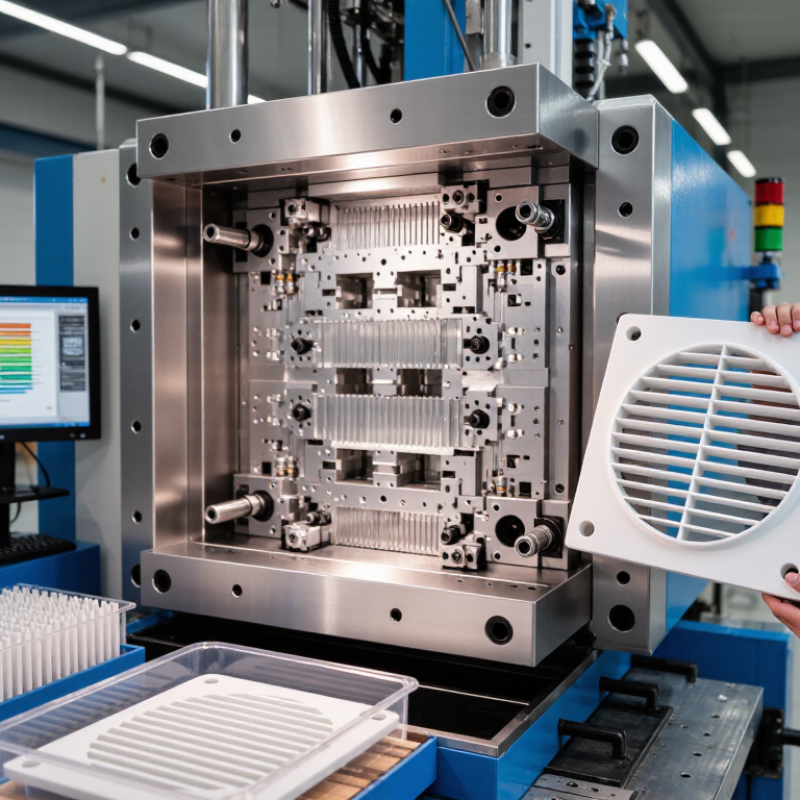
Air-conditioning molds are not one tool category. Plastic injection molds shape fan housings, drain pans, and control-panel covers. Die-casting dies form metal parts such as brackets and motor supports. Sheet-metal tooling punches, bends, and trims cabinet panels. A capable supplier should explain which process fits each component, rather than steering every part toward one machine.
Details matter on the shop floor. For an injection-molded drain pan, ask how the tool manages wall thickness, draft, and water flow. Review sample parts for sink marks and uneven edges. For die-cast components, discuss venting, cooling, and expected machining allowances. Sheet-metal tools need careful attention to bend sequence, hole position, and springback. A cabinet door can look simple. Its fit may still shift after forming.
Request trial samples, measurement records, and a clear plan for tool maintenance. Check whether the supplier can support design changes and repeat production, not just deliver a polished first sample. I would also ask to see a similar tool running, if possible. A specification sheet cannot show every small issue. Even experienced teams sometimes miss one. That is why realistic testing, open communication, and documented corrections matter more than broad claims about being the best.
Air-Conditioning Molds: Injection, Die-Casting, and Sheet-Metal Tooling
The chart compares typical material or process temperatures, not mold quality. Injection-molding temperatures vary by resin; die-casting temperatures refer to molten aluminum alloys; sheet-metal stamping is generally performed near ambient temperature. Actual conditions depend on the material and production requirements, so these ranges should not be used as a supplier ranking.
China’s AC Manufacturing Base: 244.9 Million Units Produced in 2023
Who Makes the Best Air Conditioning Molds in China?
China’s AC Manufacturing Base: 244.9 Million Units Produced in 2023
China produced 244.9 million air-conditioning units in 2023, a figure that shows the scale of its manufacturing base. That volume supports a broad ecosystem of mold makers, material suppliers, and component factories. But output alone does not prove that a mold is well designed. Scale is only part of the picture.
For plastic housings, louvers, and drain components, mold accuracy affects fit, surface finish, and production consistency. A reliable assessment should include steel specifications, cooling-channel layout, venting, and dimensional inspection. Ask whether the maker can share trial-shot records and measured sample parts. Look closely at corners and ribs. Small details matter.
A factory visit can reveal practical differences: organized tool storage, clear maintenance logs, and technicians who can explain a defect without hiding it. Mold-flow analysis may help identify filling or warpage risks, but it cannot replace a physical trial. The process is rarely perfect. Some changes appear only after parts run under real production conditions, so allow time for adjustment and verification before approving the tool.
How Mold Accuracy Is Assessed Under ISO 20457:2018
Under ISO 20457:2018, air-conditioning mold accuracy is not judged by one universal tolerance. The standard covers dimensional tolerances and acceptance conditions for molded plastic parts. A competent assessment starts with the drawing, resin, part geometry, and intended measurement method. Fit the grille, clips, and screw bosses; do not rely on a single cavity measurement.
Measure critical features with calibrated equipment after parts have cooled and stabilized. Record cavity-to-cavity variation, shrinkage, warpage, and repeatability across production runs. ISO 20457 helps define acceptance, but it cannot replace application-specific limits. Small differences matter. A warped housing may still pass a length check yet leave an uneven panel gap. The test plan should state datum points, sampling frequency, and environmental conditions.
The scale is substantial: PlasticsEurope’s Plastics – the Fast Facts 2024 reports 413.8 million tonnes of global plastics production in 2023. That figure is not air-conditioning-specific, but it underlines why consistent molded-part control matters. Ask mold suppliers for traceable inspection records and trial-part data, not just a tolerance claim. A polished report can still hide weak sampling. I would also question measurements taken only from warm, newly ejected parts; they may not reflect stable dimensions.
Comparing Mold Makers by Tool Life, Cycle Time, and Defect Rate
Choosing an air-conditioning mold maker in China requires more than comparing quotations. Tool life should be tied to the mold’s steel, cooling layout, maintenance plan, and expected production volume. The Society of the Plastics Industry’s mold classification guide places Class 101 tooling at one million cycles or more, while Class 103 covers 100,000 to fewer than 500,000 cycles. These are classification thresholds, not guarantees. Ask suppliers to state the intended class and the conditions behind their estimate.
Cycle time is easiest to compare on the same resin, part, machine, and cooling conditions. Record the median across 500 stable shots, including cooling and ejection; a fast cycle that causes warpage is not a real gain. Inspect the cooling channels, too. Uneven water flow can leave one corner hot while the rest of the housing looks ready. Small detail, big consequence.
Defect rate needs a clear denominator. During a 10,000-shot trial, count flash, short shots, sink marks, and dimensional failures, then calculate defects per thousand parts. ISO 20457:2018 provides a framework for tolerances in molded plastic parts, but it does not set one universal defect-rate target. Compare each maker against the same drawing and acceptance rules. One imperfect point: trial conditions rarely match a full production shift, so ask for process records, not just a polished sample.
Who Makes the Best Air Conditioning Molds in China? Comparing Mold Makers by Tool Life, Cycle Time, and Defect Rate
The profiles below are illustrative planning benchmarks, not audited results or claims about specific Chinese suppliers. They assume a comparable medium-sized injection-molded AC housing or grille, similar resin and part geometry, and production conditions agreed in advance. Actual results depend on the design, steel, maintenance, machine, and quality-measurement method.
| Generic maker profile |
Indicative mold life |
Indicative cycle time |
Indicative defect rate |
Typical strengths and trade-offs |
Best fit |
| High-volume, production-focused |
About 500,000–1,000,000+ shots, subject to maintenance and wear limits |
About 35–55 seconds per shot |
About 0.5–1.5% after process stabilization |
Higher upfront tooling and validation effort; usually prioritizes robust steel, cooling, repeatability, and preventive maintenance. |
Long-running programs and high annual volumes |
| Balanced production supplier |
About 200,000–500,000 shots, depending on mold construction and upkeep |
About 40–65 seconds per shot |
About 1–3% after process stabilization |
Often balances tooling cost, lead time, and production durability; performance can vary with cooling design and process control. |
Medium-volume programs with cost and lifespan requirements |
| Cost- or schedule-focused |
About 50,000–200,000 shots, depending on steel, design, and maintenance |
About 45–75 seconds per shot |
About 2–5% during early production; confirm the stabilized rate in a trial |
May reduce initial cost or lead time; verify spare parts, mold service, dimensional consistency, and trial-run acceptance criteria. |
Prototype, launch, or shorter-life production needs |
How to compare suppliers fairly: request the same part-specific cycle-time target, tool-life definition, defect categories, sampling period, and production-trial conditions from each bidder. Tool life is not a guaranteed shot count unless the contract defines maintenance, wear limits, and acceptance criteria; defect-rate figures should specify whether they cover trial runs or stable mass production.
Who Makes the Best Molds? Verify Capacity, Case Studies, and Service Support
Choosing an air-conditioning mold maker requires more than a large workshop. The International Energy Agency’s 2018 report, The Future of Cooling, projected that global energy demand for space cooling could reach 6,200 TWh annually by 2050. That growth makes repeatable production important. Ask suppliers to show machine tonnage, mold dimensions, monthly loading, and recent trial records—not just a list of equipment. Numbers can mislead.
For an AC grille or condensate tray, request a case study with the part drawing, resin, cavity count, cycle time, and inspection results. Check whether the sample was measured after molding and whether reported dimensions match your critical tolerances. A polished sample proves little. Review mold-flow analysis, cooling-channel layout, steel certificates, and a documented correction process. If possible, compare a trial part with your own gauge or coordinate-measuring report.
Service support matters after shipment. Confirm who handles setup, spare inserts, preventive maintenance, and urgent troubleshooting across time zones. Ask for realistic response times and written warranty terms. A supplier’s past project is useful, but it may not match your geometry or resin. That gap deserves discussion. A factory visit can help, yet production records and customer references offer stronger evidence than photographs alone.